From two leaves and a dry stick to a second bloom.
Someone gave it to you with six open flowers and a ribbon. The flowers lasted two months, then dropped, and since then it has just sat there. It's almost always resting. This book shows you what it's waiting for, how to give it that in your home, and what to do on all the days in between: mostly nothing.
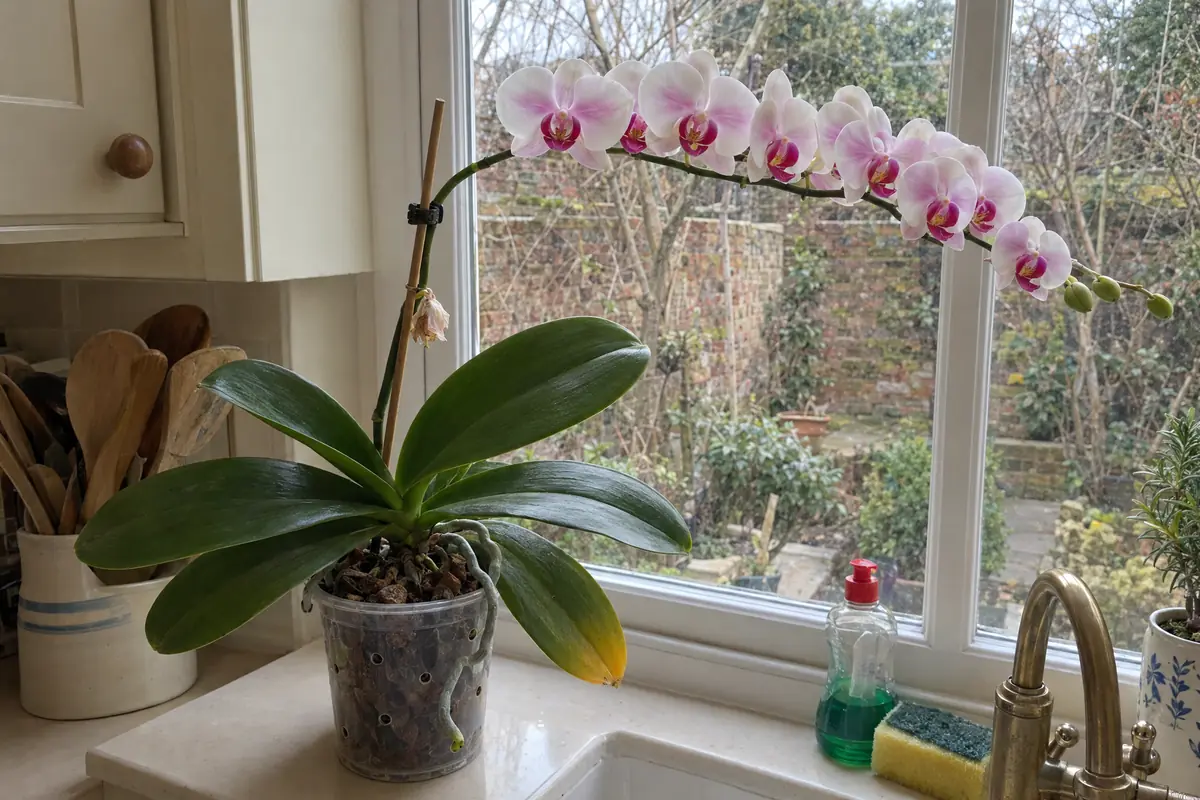
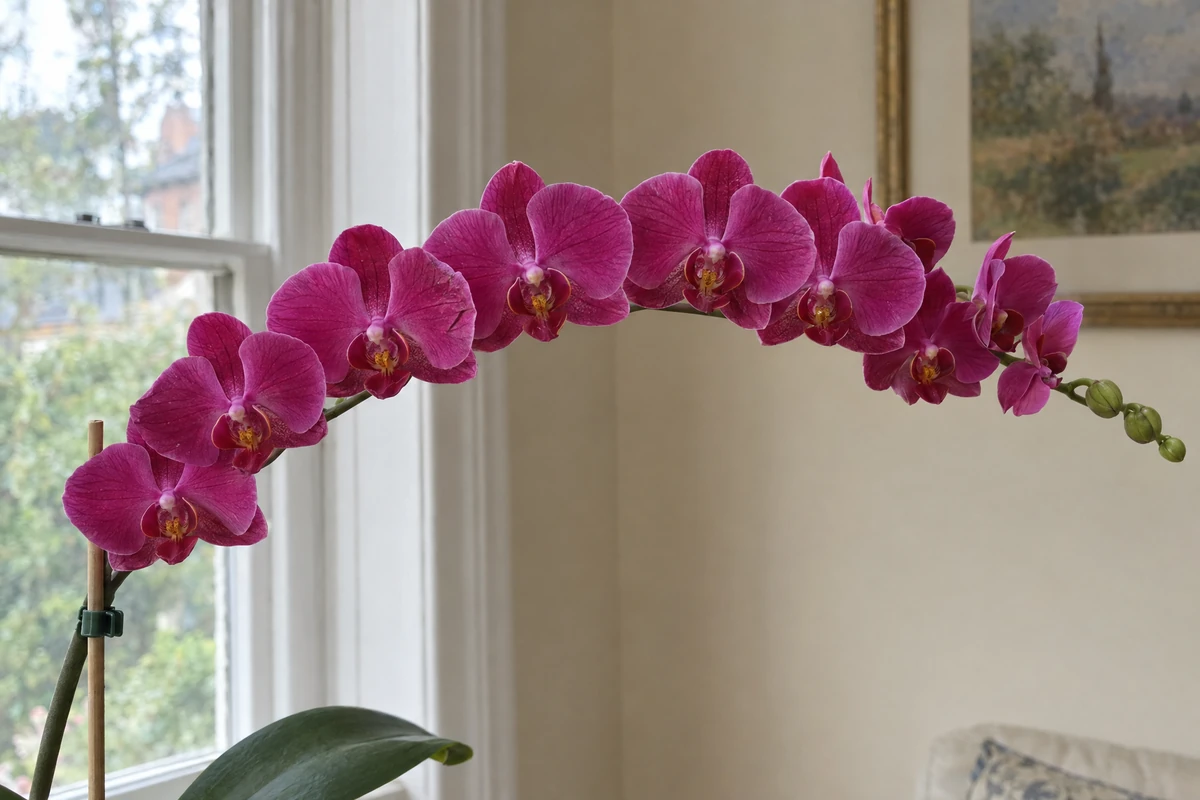
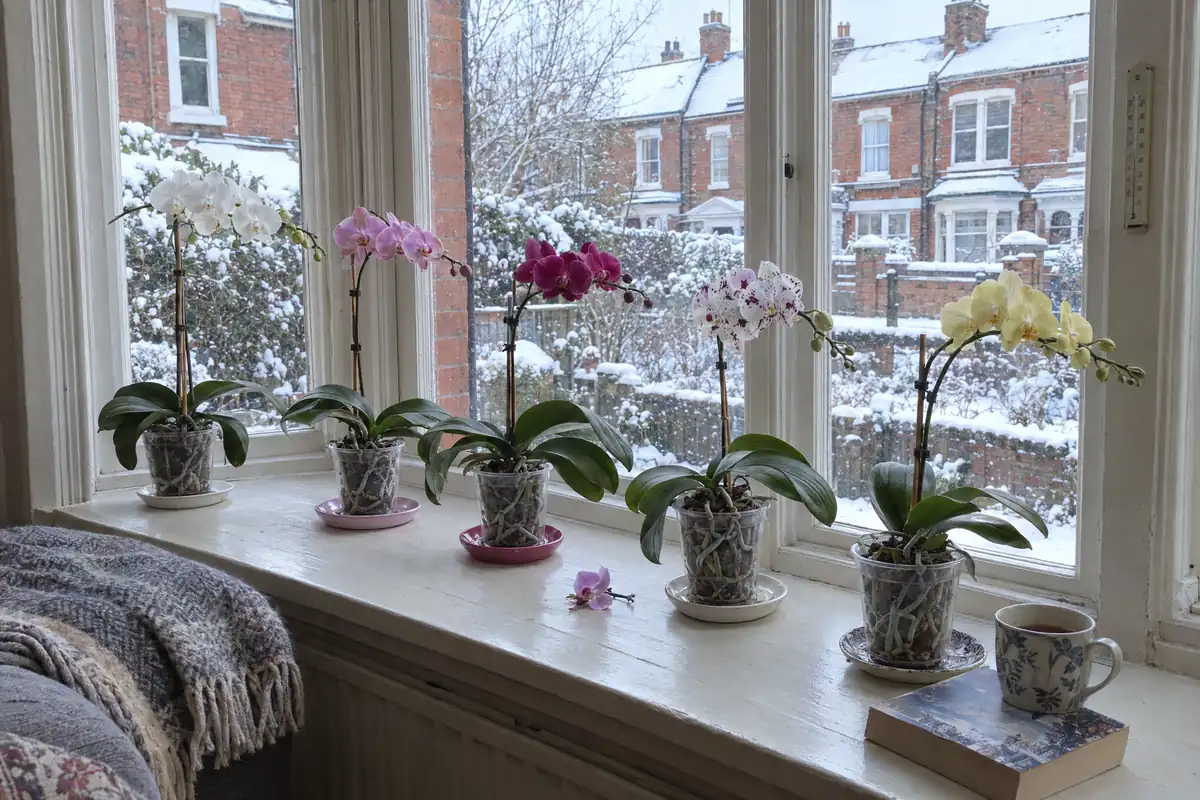
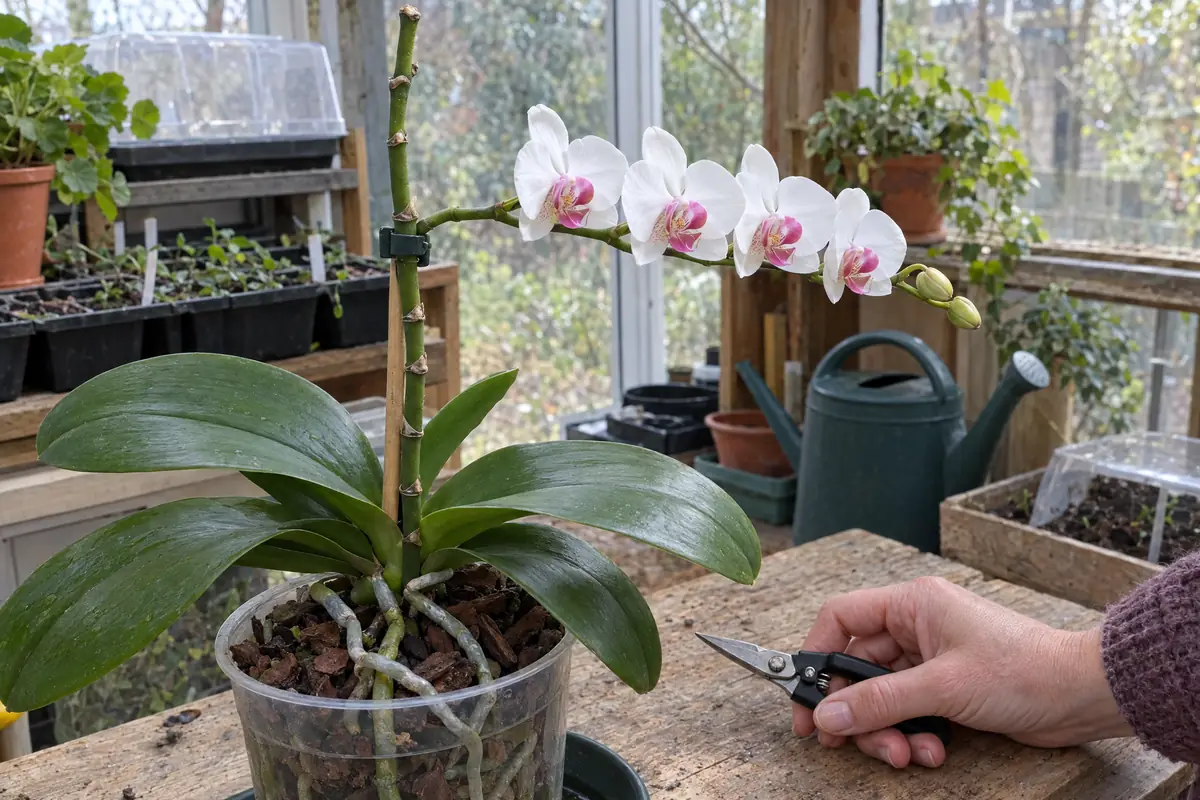

The same kitchen orchid, flowering again.
Make the one you have bloom again.
Lost one to rot before? Start here.
- 🌸 The orchid you were given, in flower again
- 🌡️ The cool weeks that bring the spike back
- 📅 What to do each month, in your hemisphere
- 💧 Why it stopped blooming, and why it rotted
What's in each volume
How you receive it
Payment terms
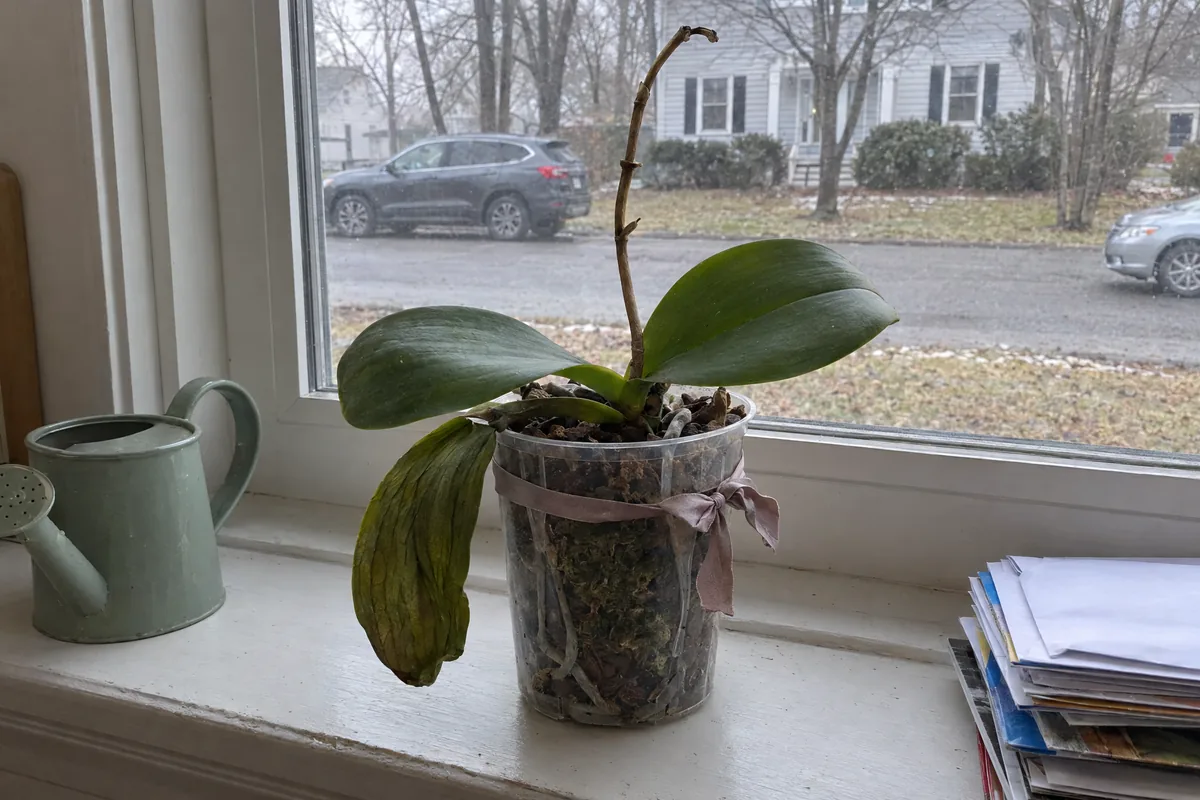
The tag said "water once a week." That's where it started.
Some people throw it out when the flowers fall. Others water it more, out of love, and it rots. Others cut it right down "so it grows back." All three did what they were told.
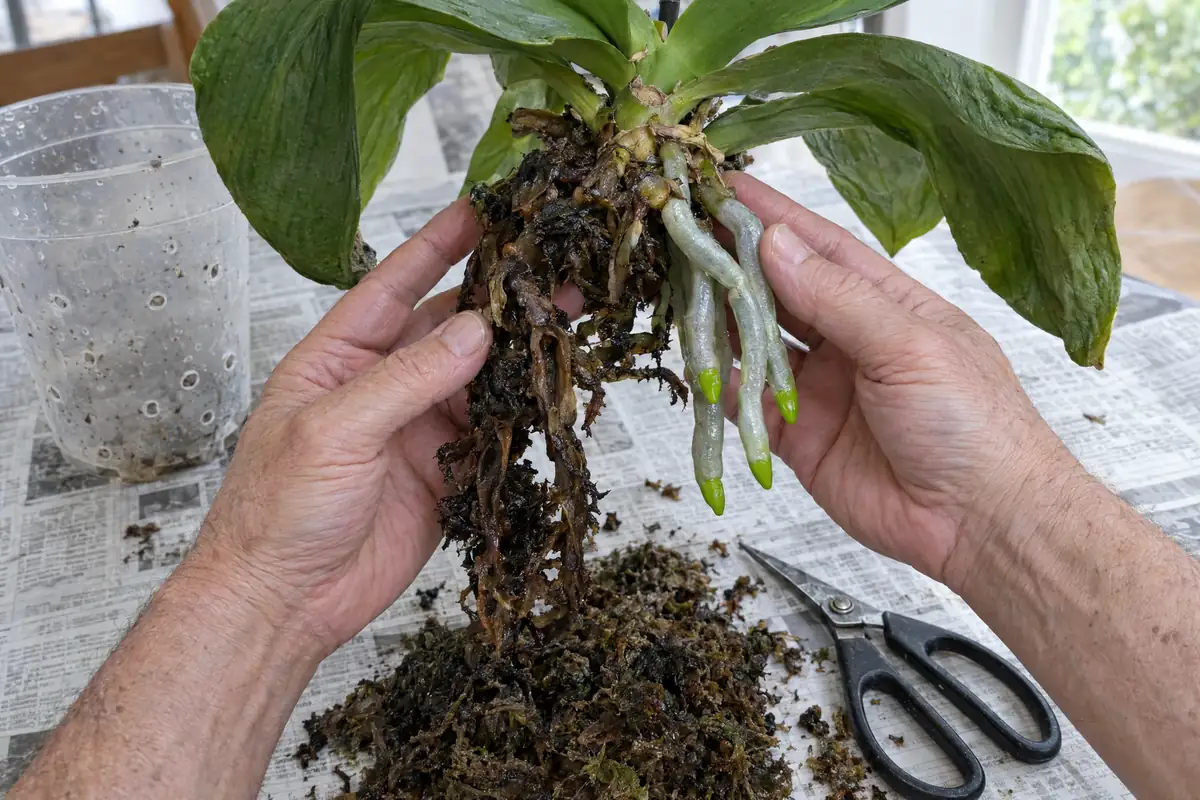
Here's what the tag leaves out. Most store orchids hide a packed ball of moss in the center of the pot that stays wet for weeks while the bark around it dries in days. And the spike comes back after a few weeks of cool days, below about 23 °C (73 °F). In a warm room it waits.
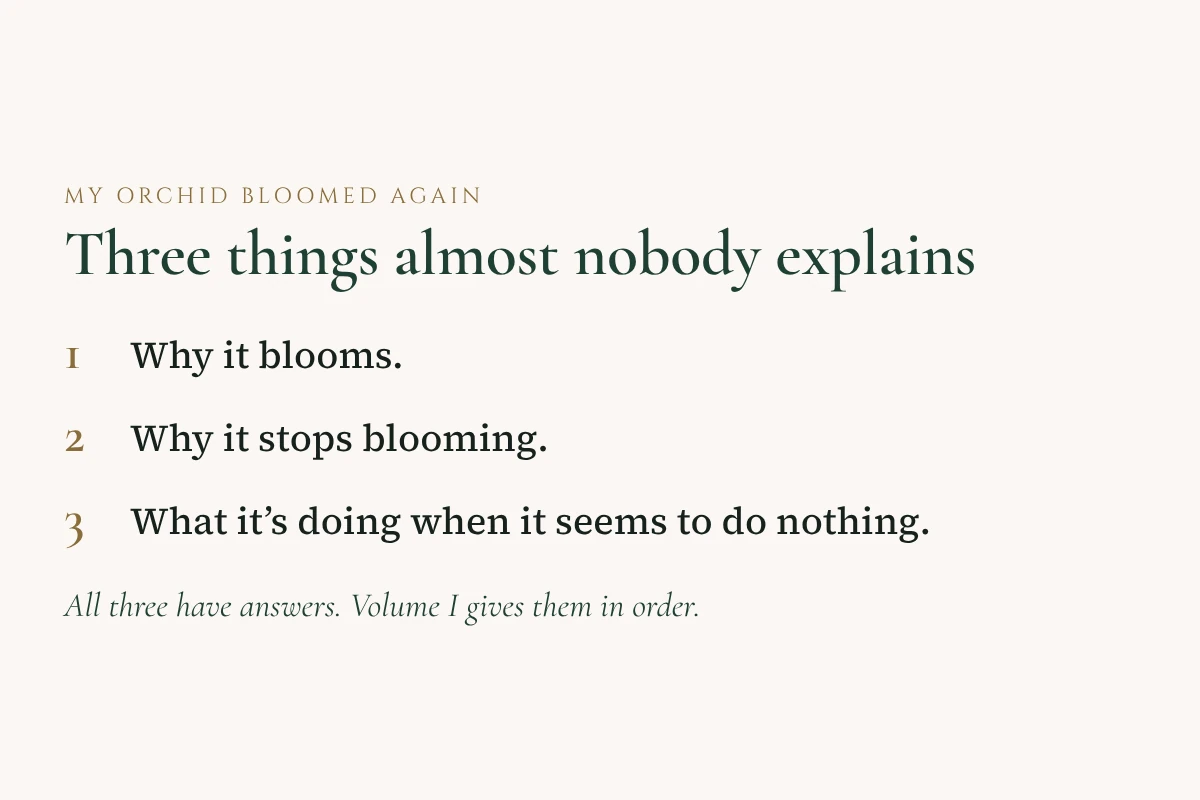
A green thumb is optional. What it takes is three answers: why it blooms, why it stops, and what it's doing when it seems to do nothing. This book gives you all three, with the source for every figure.
The orchid you have, a clear pot, a bright window.
That's all. The book tells you how to check each one before you change anything.
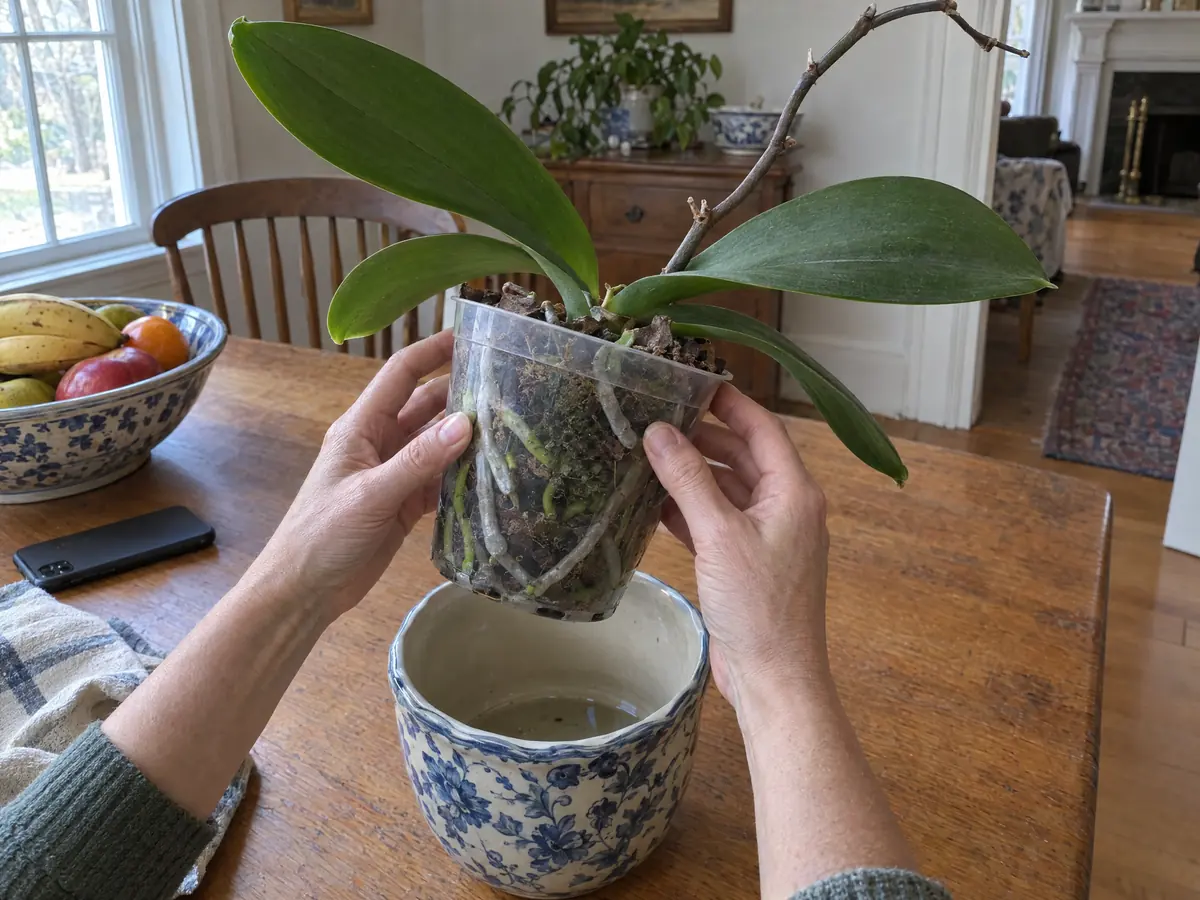
The one from the supermarket counts. Lift it out of the decorative pot and look at the roots through the plastic: they tell you more than the flowers. If you're buying your first, the book tells you what to look for on the shelf.
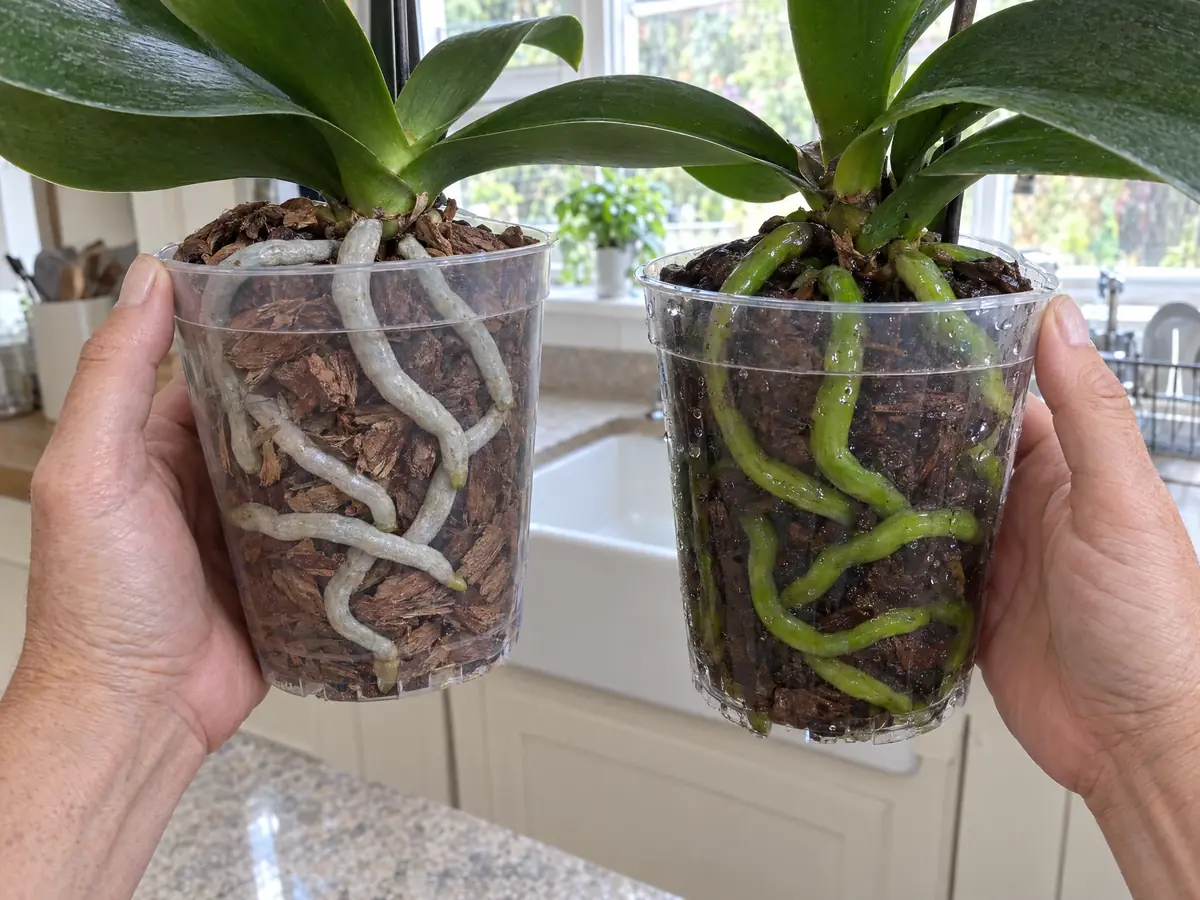
Keep the clear pot with holes, with chunky bark inside. Silver roots: water. Green roots: wait. Soil of any kind never goes in.
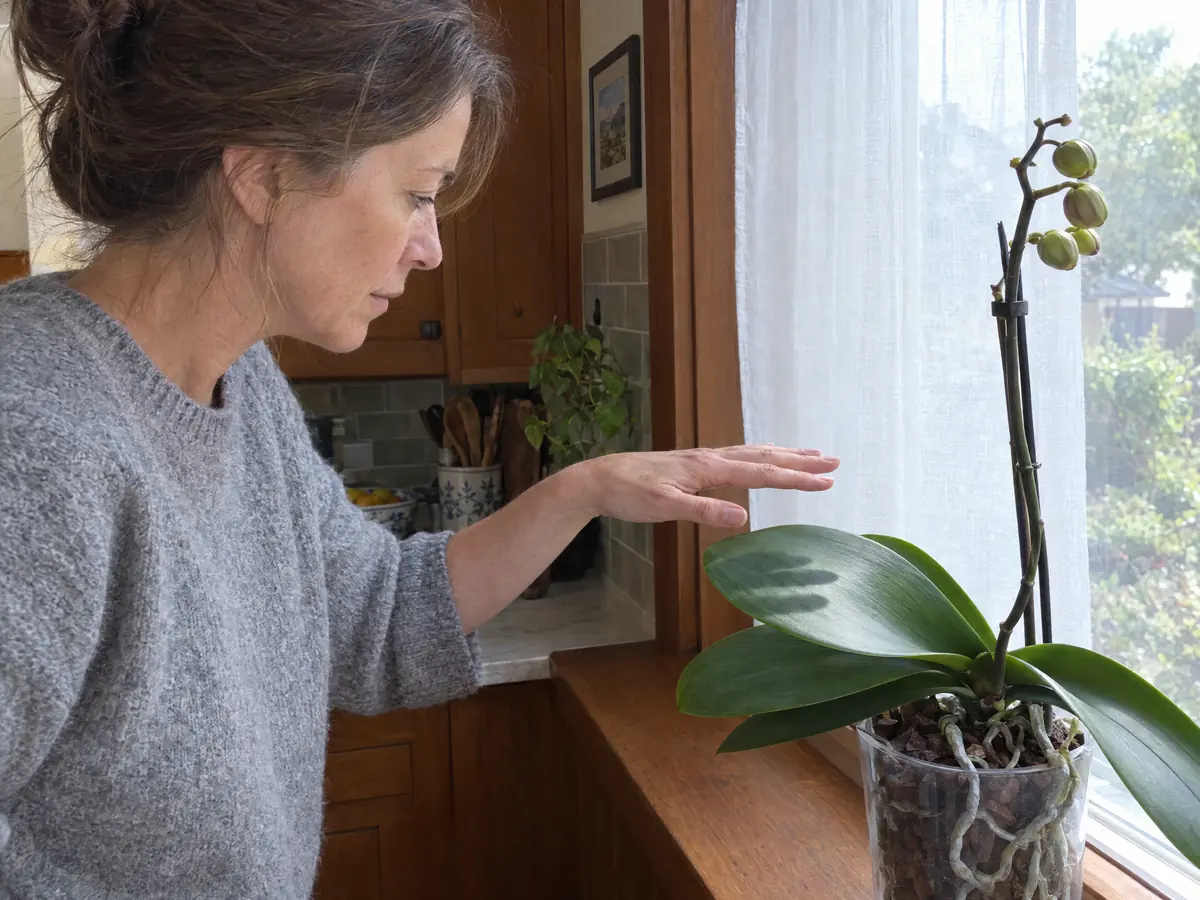
Hold your hand 30 cm (12 in) over the leaves at midday. A soft, blurred shadow means you've found the spot. A black shadow means too much sun. No shadow, too little.
A "pretty" pot without holes: water sits in the bottom and drowns the roots. Potting soil, even the good kind. A bag of ice: the book explains what the one study on ice cubes found, and why a small glass of lukewarm water does the same job.
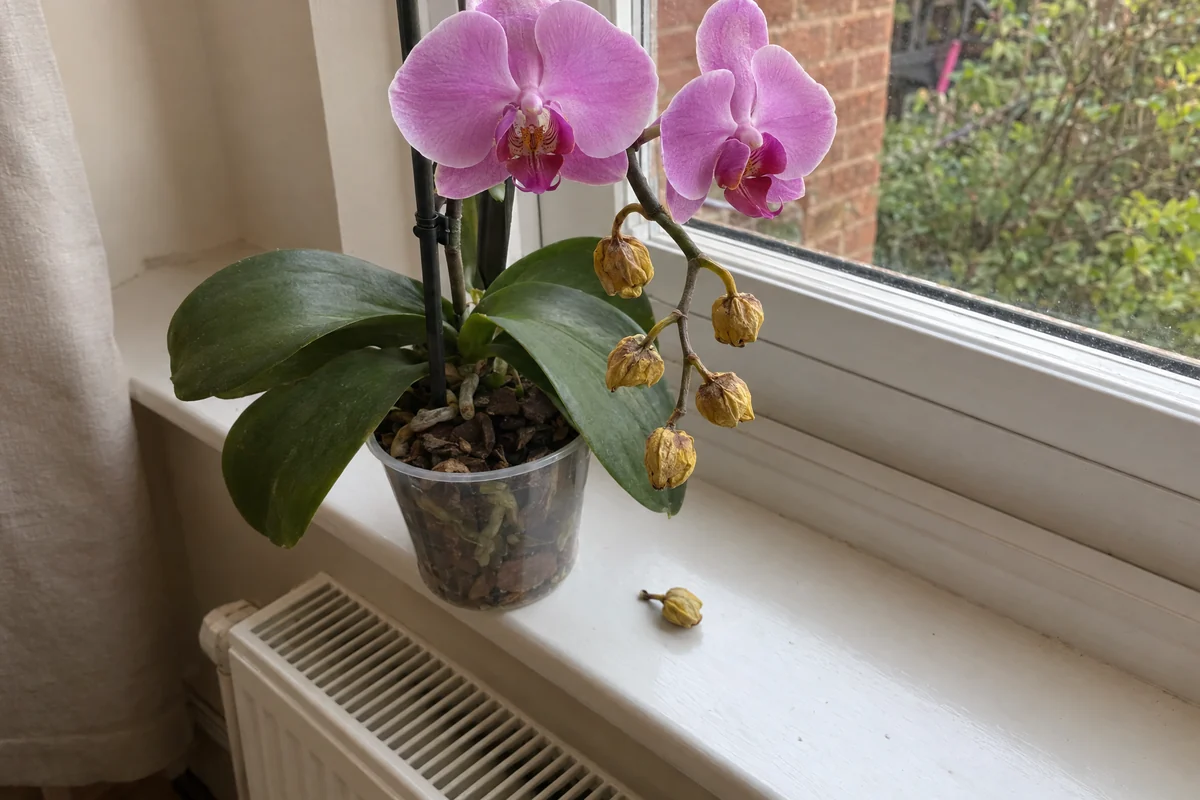
One spike changes the plant. A few winters change you.
You stop wondering whether it's dead. You know what it's doing.
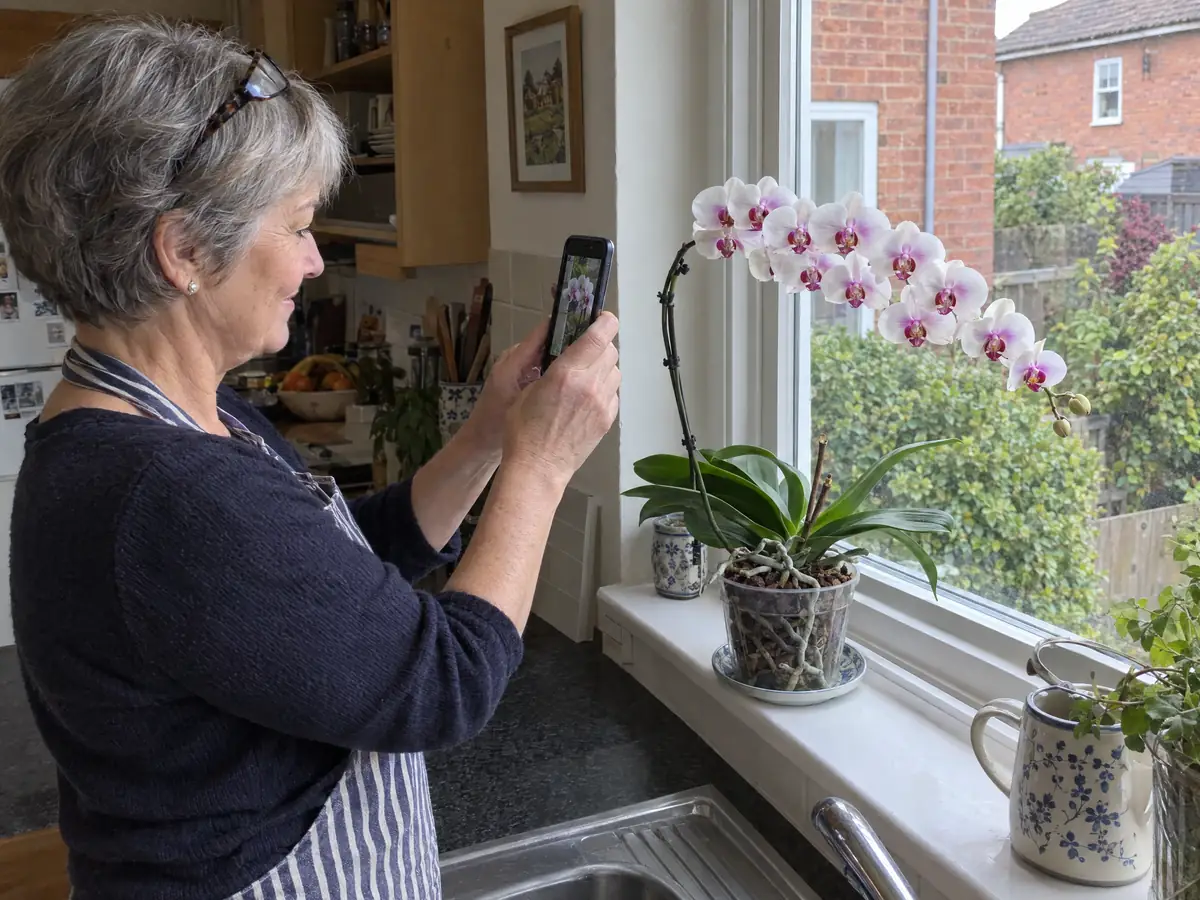
The first time it flowered, a shop did it. This time you did. You'll take a photo of it, and you won't feel silly.
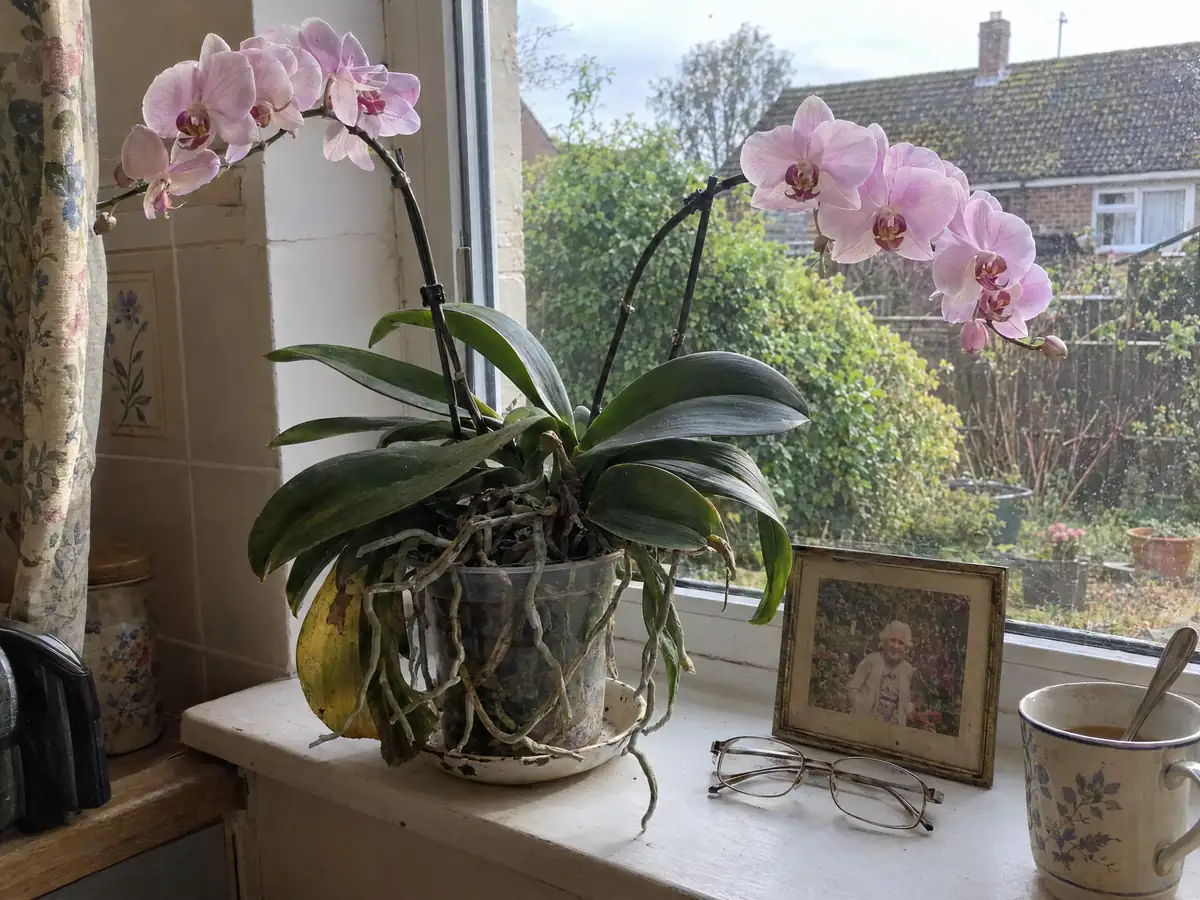
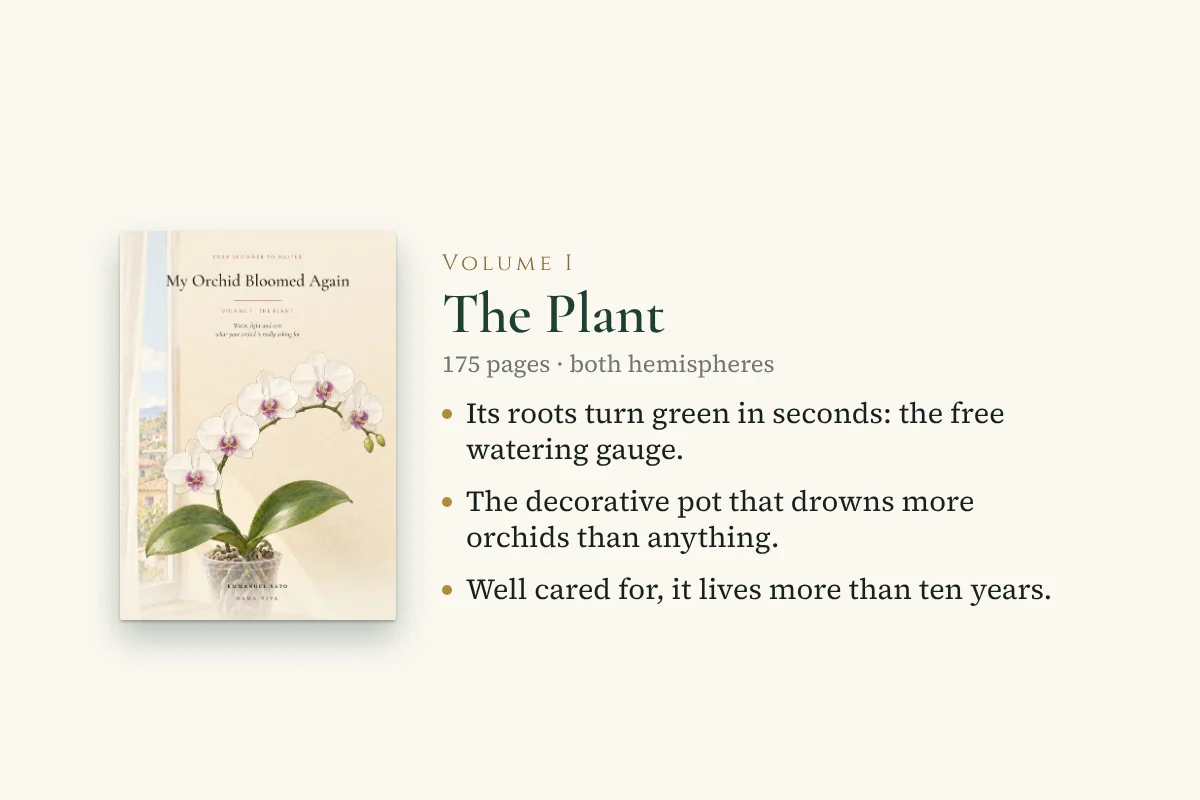
Well cared for, a Phalaenopsis lives more than ten years and blooms once or twice a year. The one from your mother's kitchen can stay in yours.
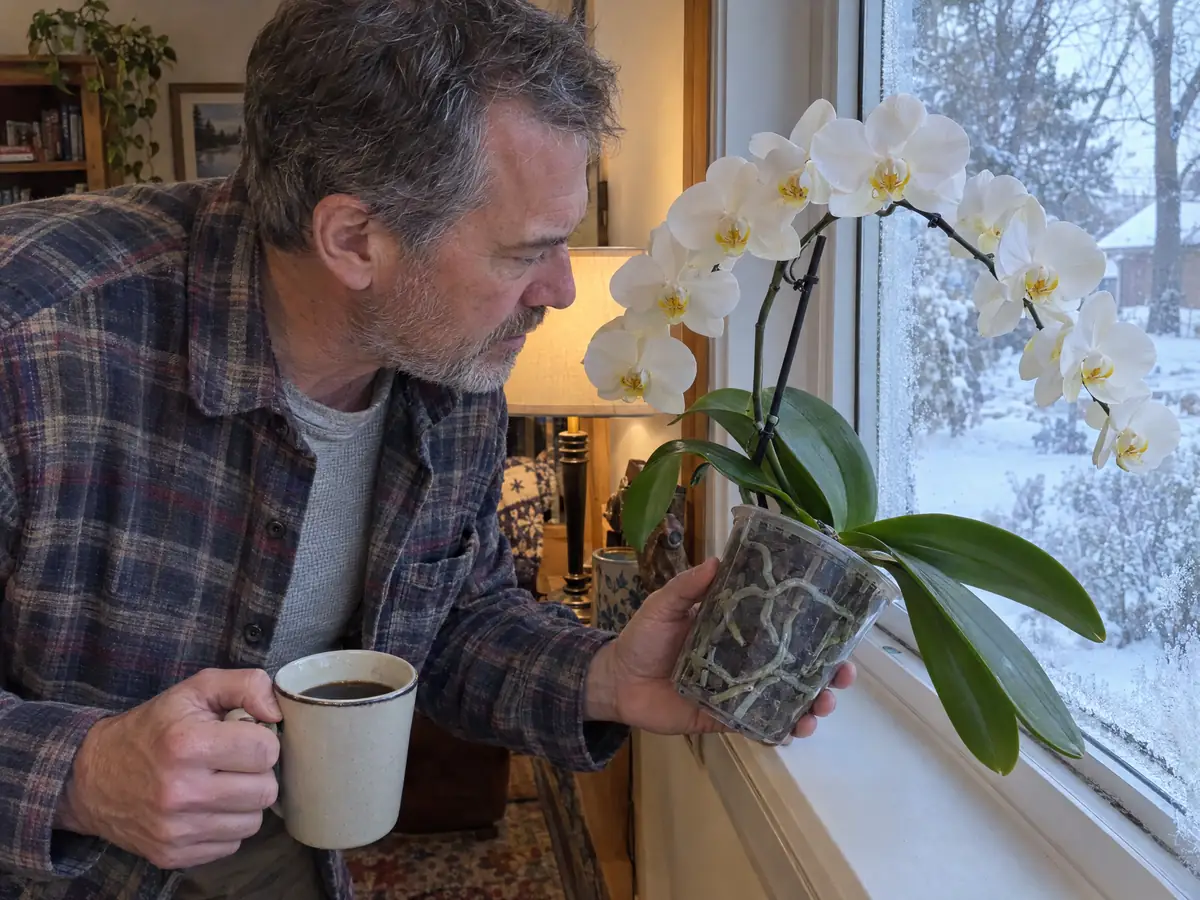
Its season is the cold one. Cool autumn days set it up, the spike shows in winter, and the flowers come by late winter or spring. A glance at the roots with your coffee tells you if it needs water.
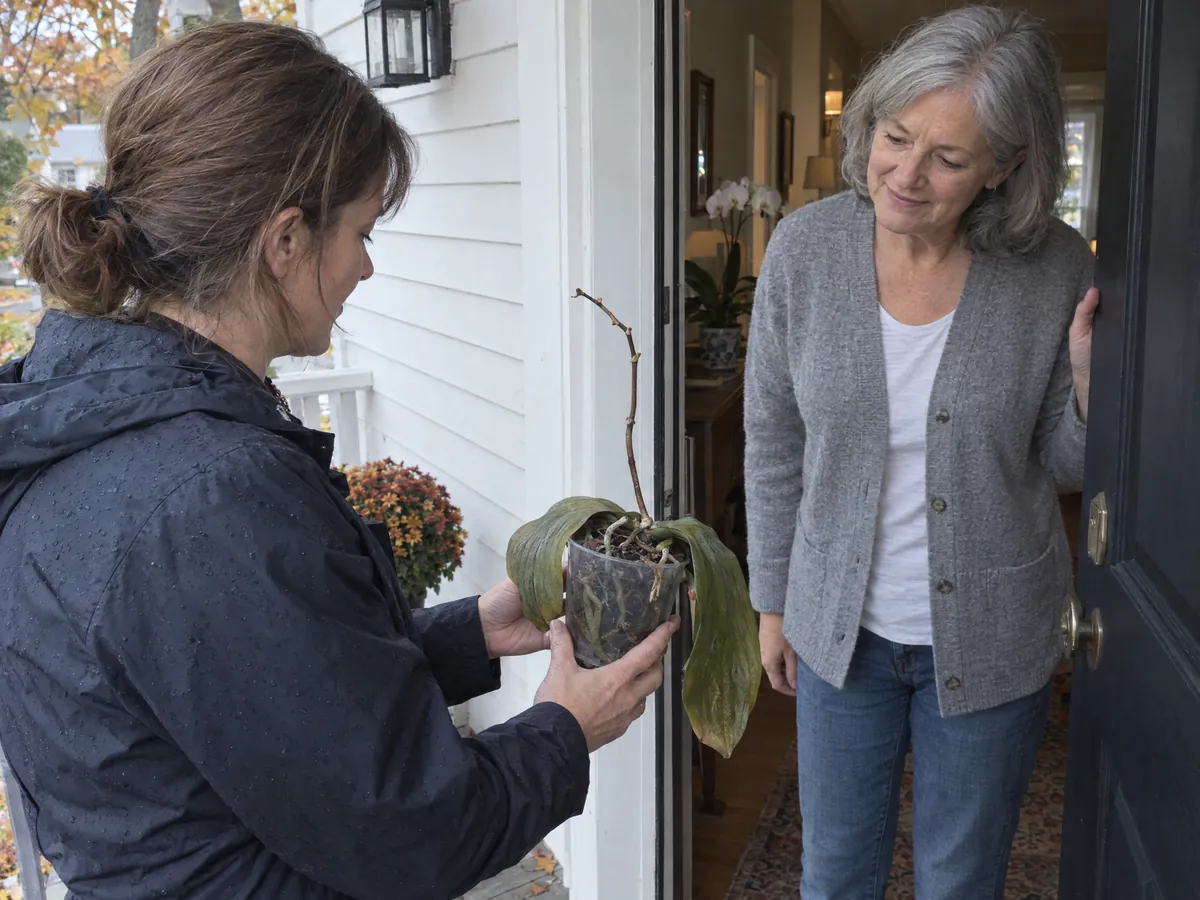
Someone sees yours in flower for the third time and brings you theirs in a supermarket bag. Volume II starts right there.
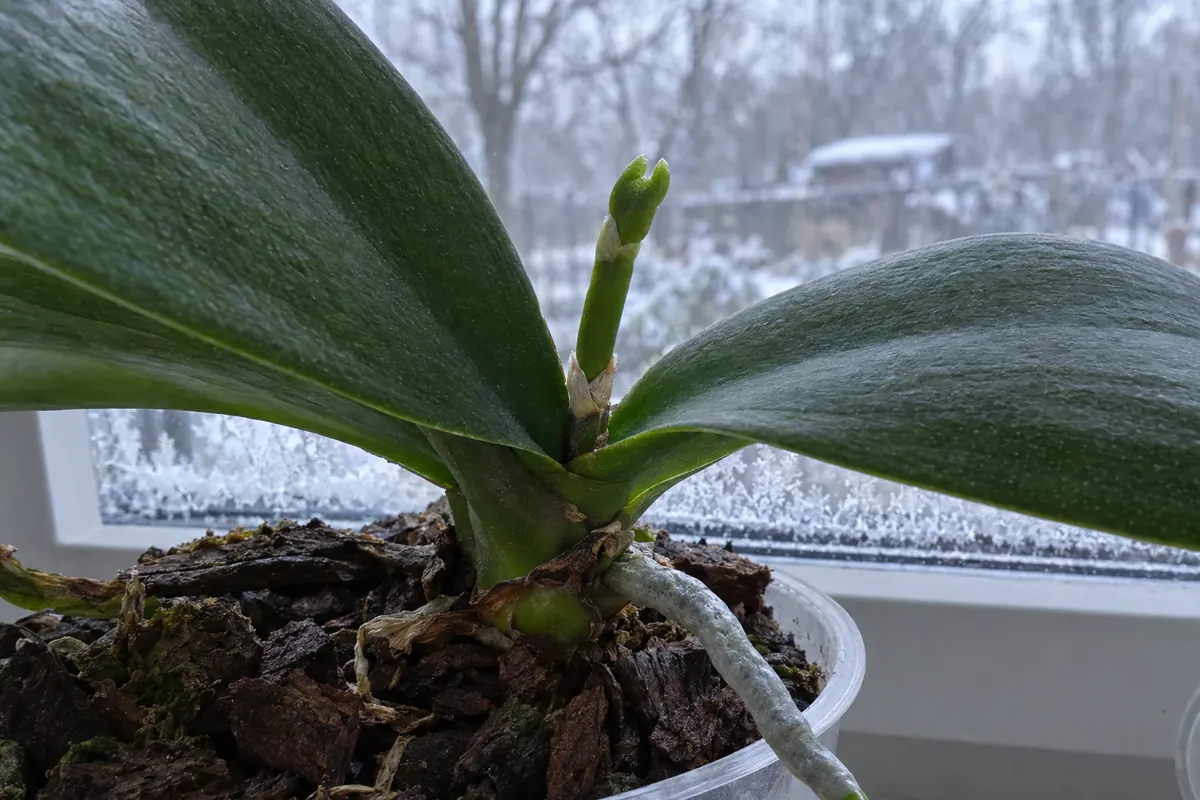
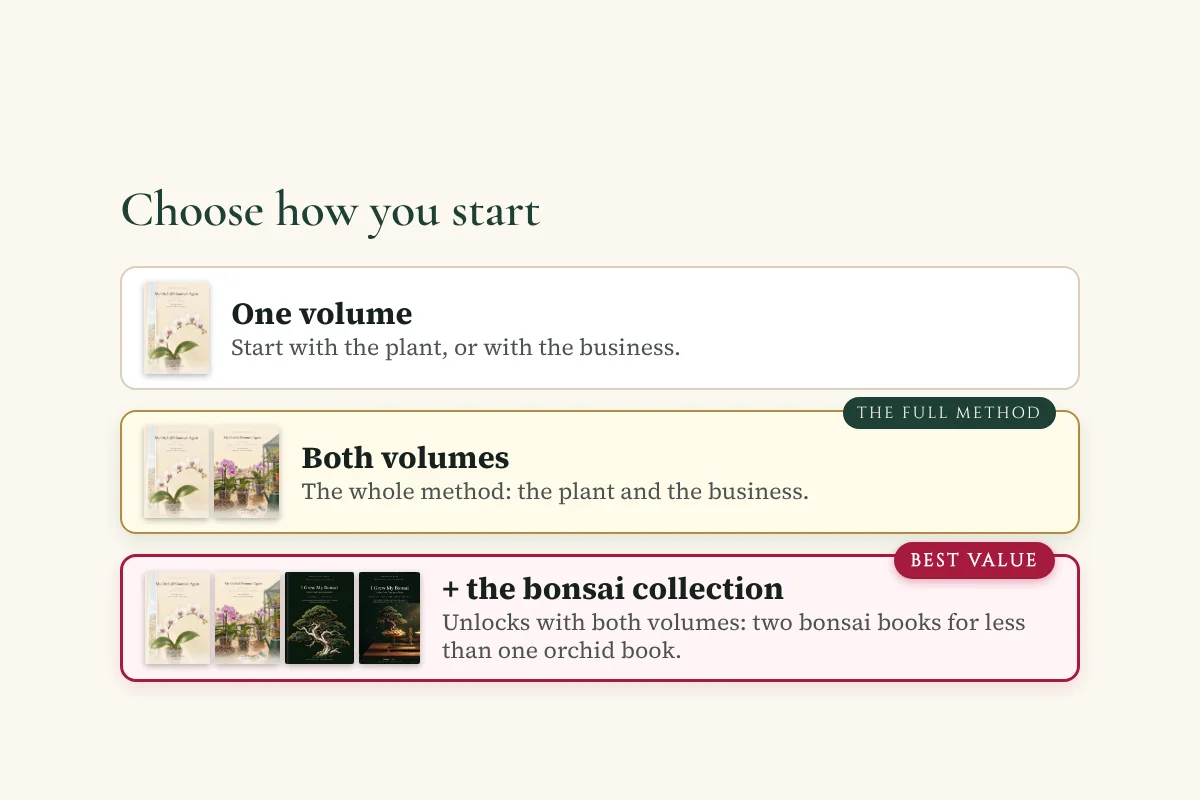
Two volumes. From the kitchen orchid to the one people ask about.
Volume I teaches you to see the plant, understand it and work on it. Volume II is for the day a neighbor asks how you do it. Every figure and every timing comes with its source, because plenty of orchid advice circulates and very little of it comes with a receipt.
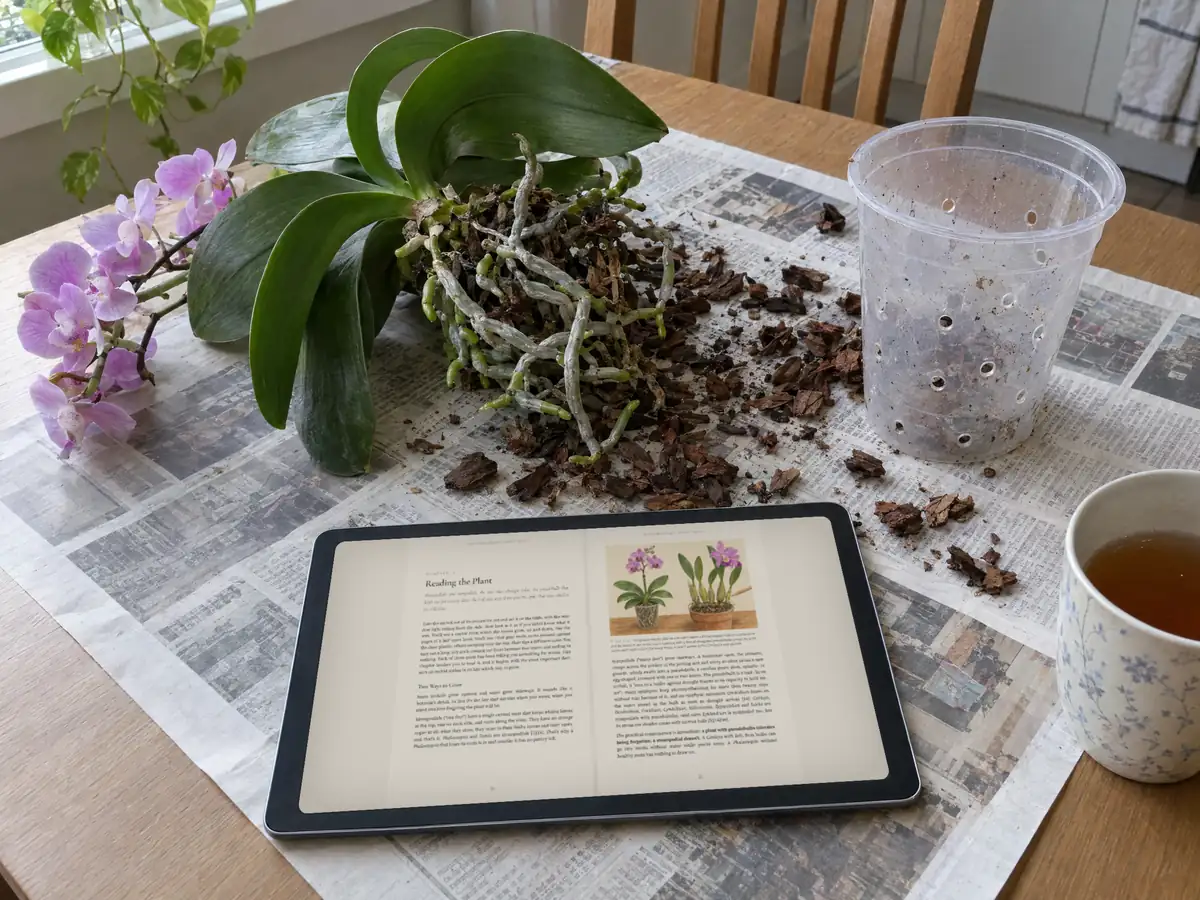
The root that changes color, the leaf that says thirst, and the spike you can scratch with a fingernail to know if it's alive.
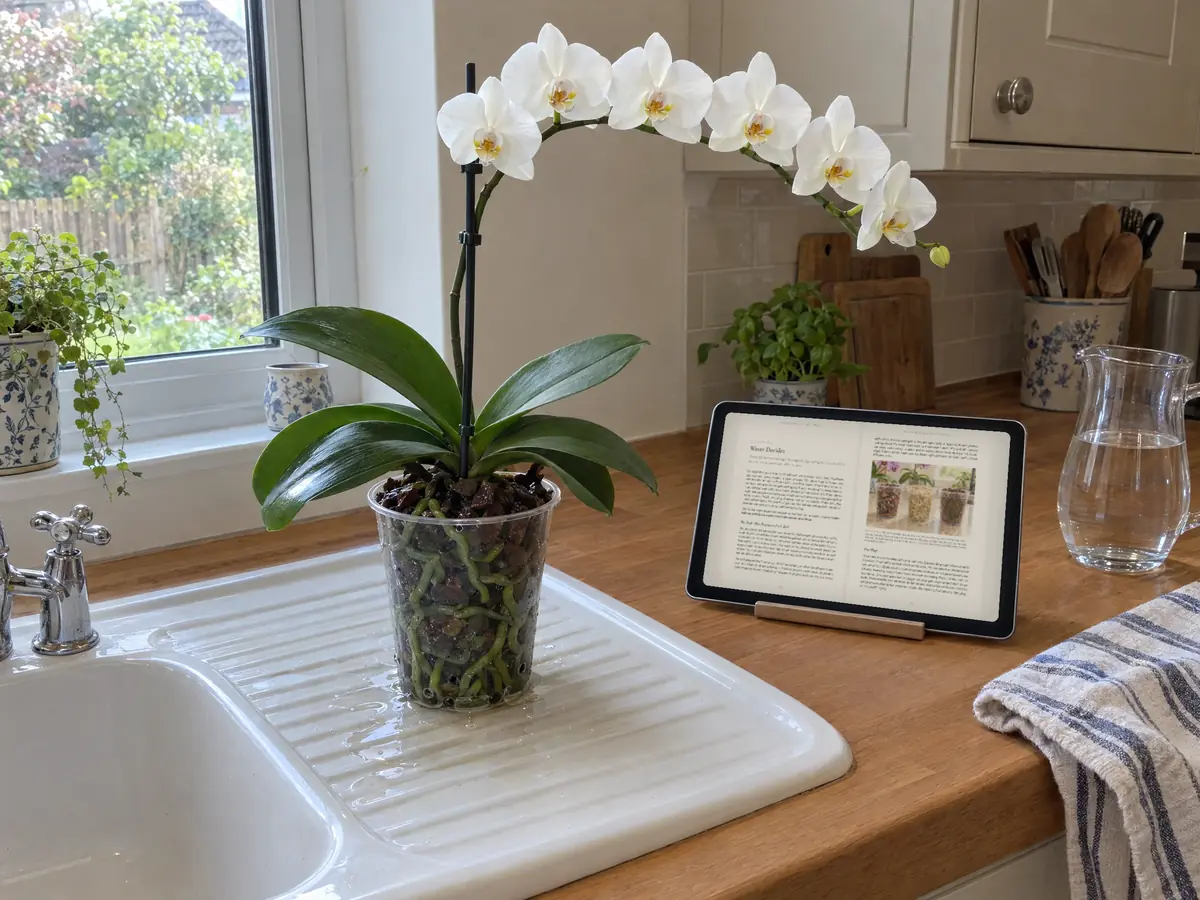
Why "once a week" drowns them, the moss plug hidden in the pot, and what a real study found about ice cubes.
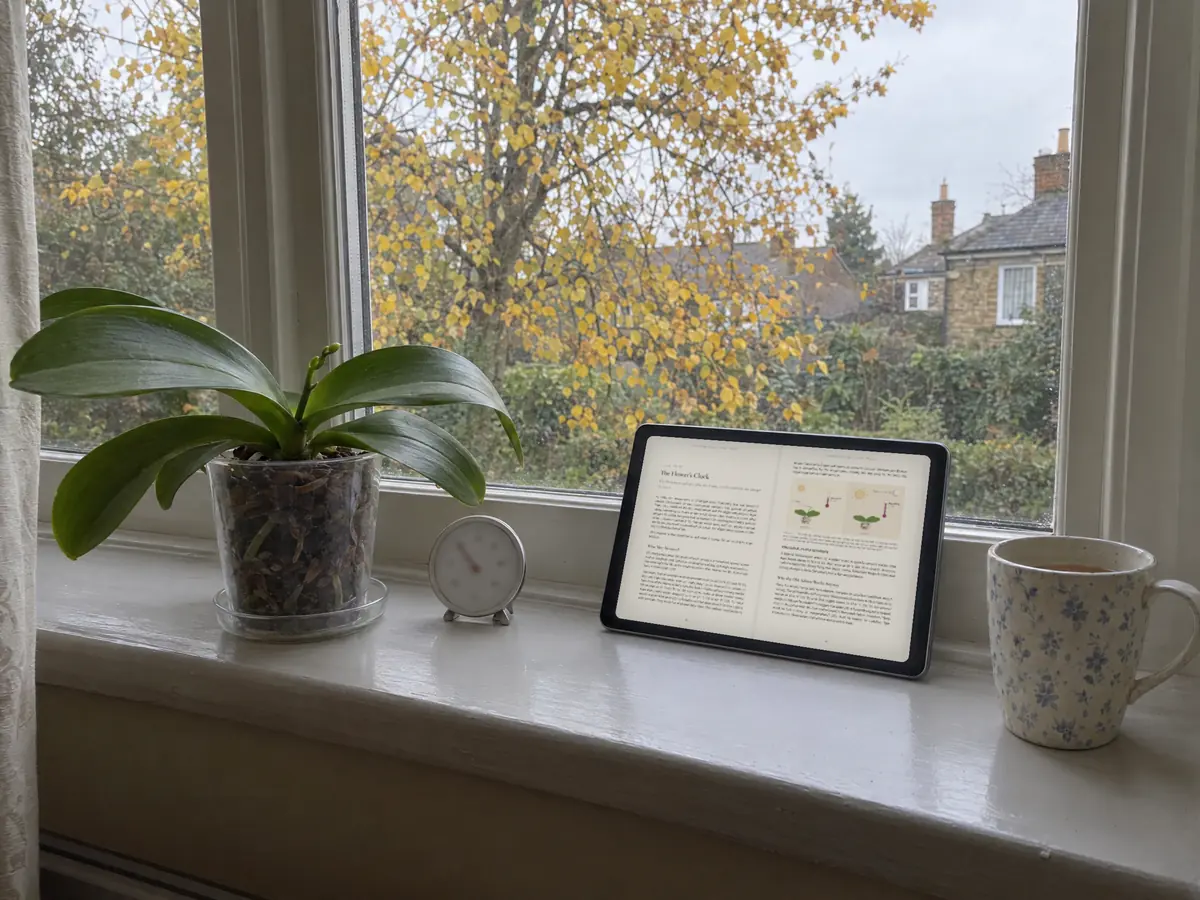
What triggers the spike, the heat that switches it off, and what to do this autumn so it flowers this winter.
Those three keep the plant you have alive and set it up to flower. The rest of the book is for the second spike, the keiki, the first repotting and the year after.
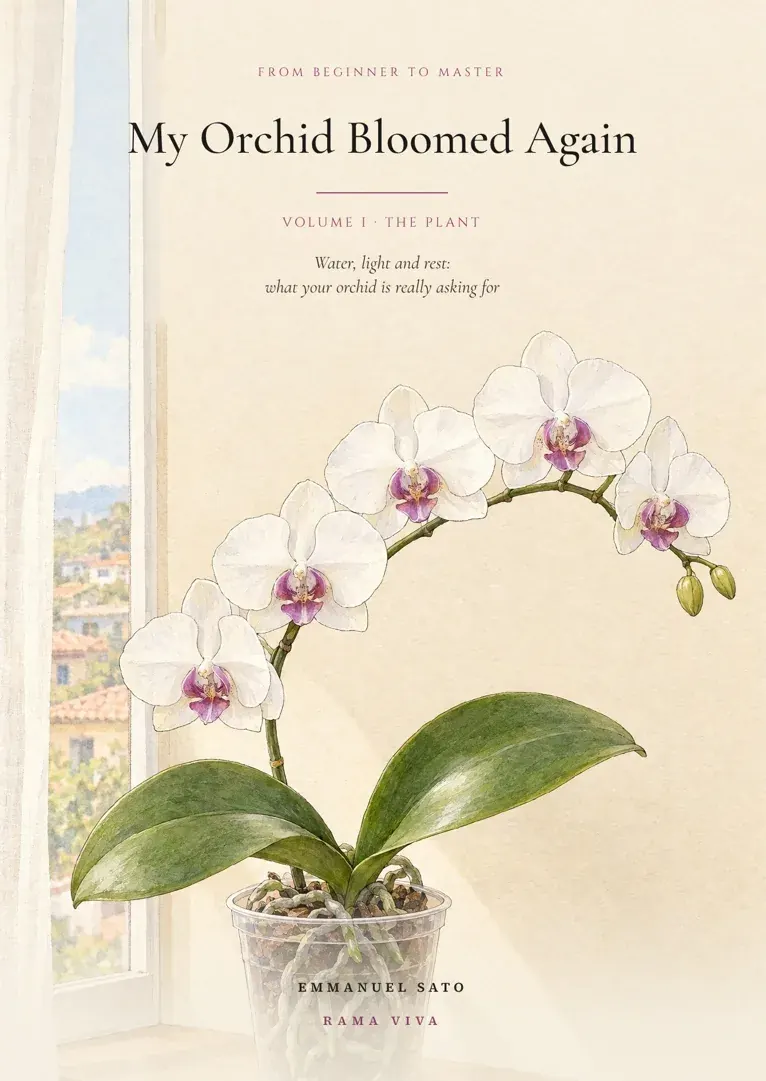
The Plant
Start here.
- Where the supermarket orchid comes from, and why it lives on air
- Reading the plant: roots, leaves, pseudobulbs and spikes
- Nine genera, with a table to match one to your window
- The flower's clock: why it blooms and why it doesn't
- Light you can check with the shadow of your hand
- Watering: the moss plug, ice cubes and the crown that rots
- Bark, sphagnum, coir and clay, and when each one fits
- Weak fertilizer, little and often
- The first repotting, and what to do with the spike: cut it or not, and the node that decides
- Keikis and division, pests with their names, and the rescue of a plant with no roots left
- The orchids native to your country, and the law that protects them
- The orchid's year by phase, with the months for both hemispheres
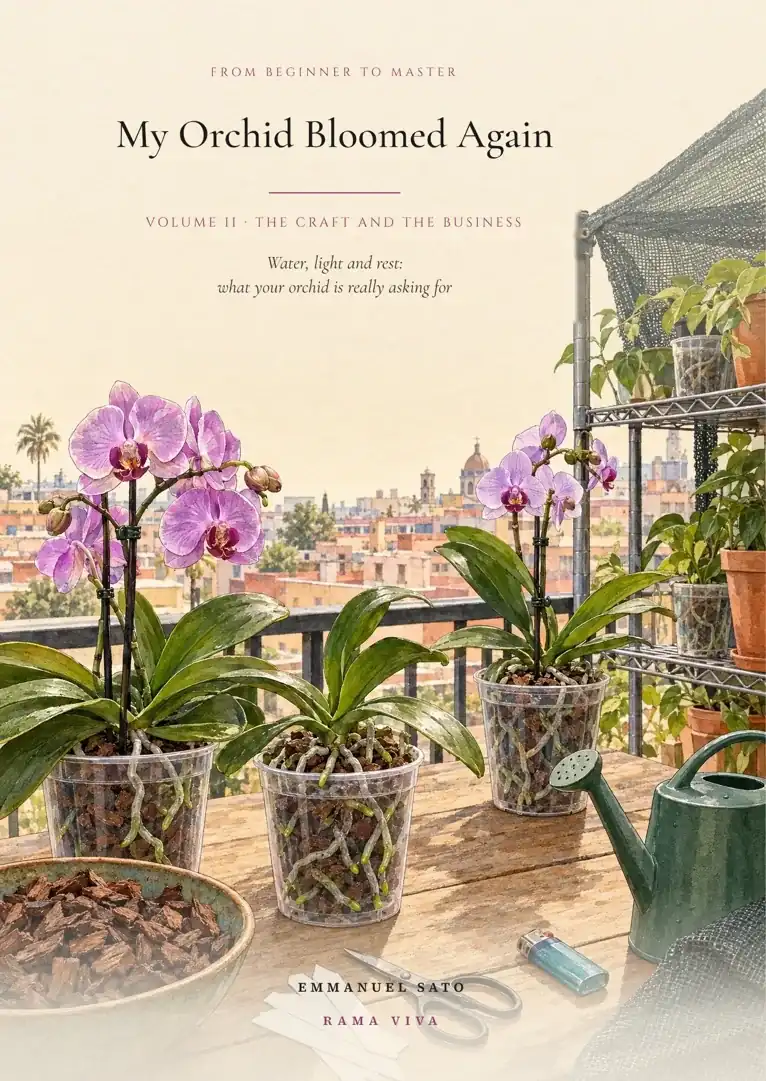
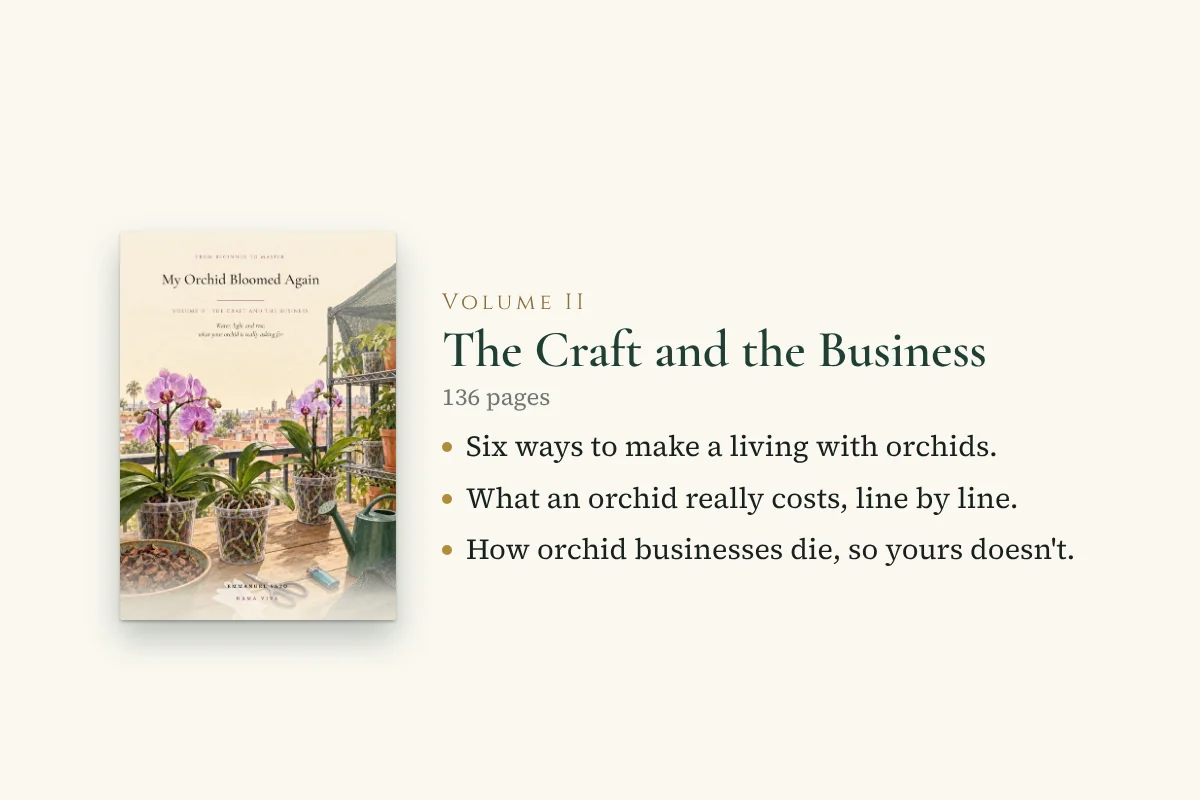
The Craft and the Business
For when a neighbor sees it bloom a third time and asks how you do it.
- The market that gets given away, with figures and their sources
- Six ways to make a living with orchids, from the orchid hospital to the small nursery
- The flower's clock turned into a pipeline
- What an orchid costs you: unit cost, price and margin for each product
- Three starting budgets and a 36-month projection with its cash valley
- Selling without pushing: the gift dates, workshops and the hospital as your shop window
- Operations: quarantine, sterilizing and plant records
- What to check, legally and for tax, in the US, UK, Canada, Australia and New Zealand
- How orchid businesses die, and your first twelve months, month by month
Costs and projections are working assumptions, converted from the author's Mexican numbers and marked as such in the book, for you to swap with your own. The book doesn't promise income or give financial, legal or tax advice.

On your phone, next to the plant.
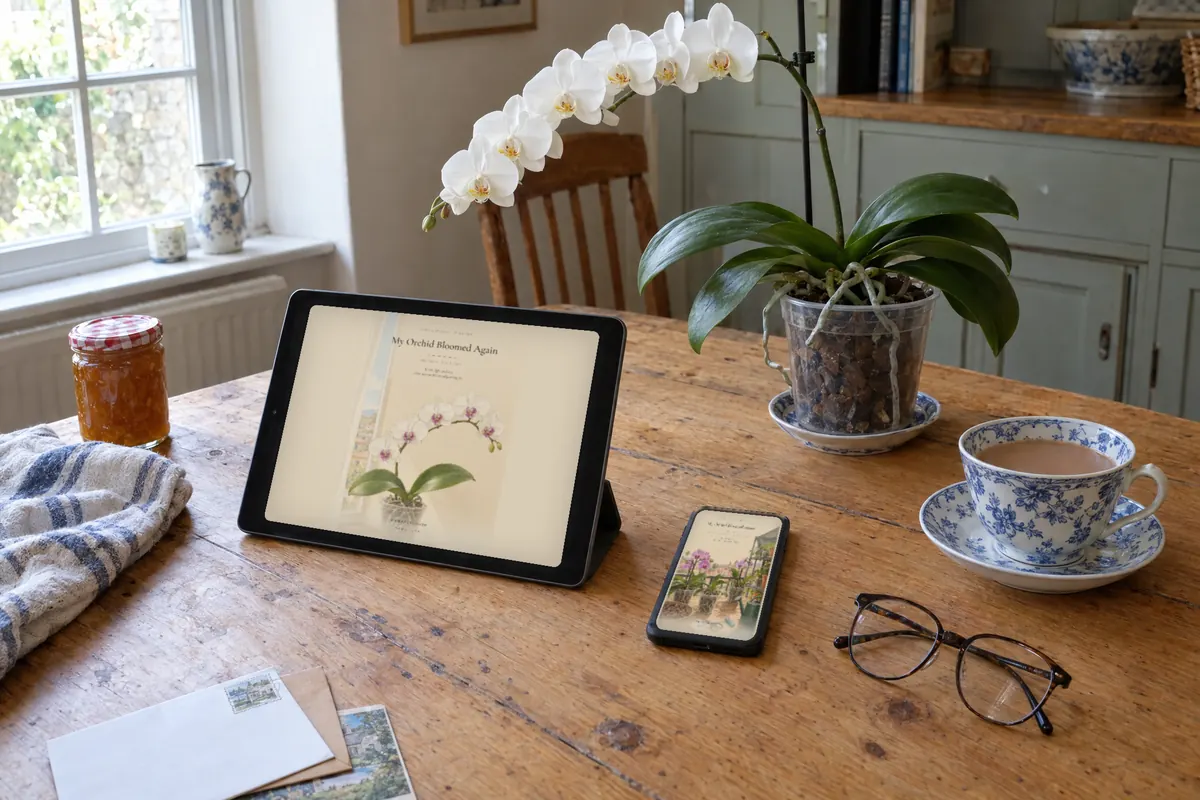
Full-color PDF. Read it with the pot in your other hand, on a tablet in the evening, or print the tables and stick them up by the window. No app, no account.
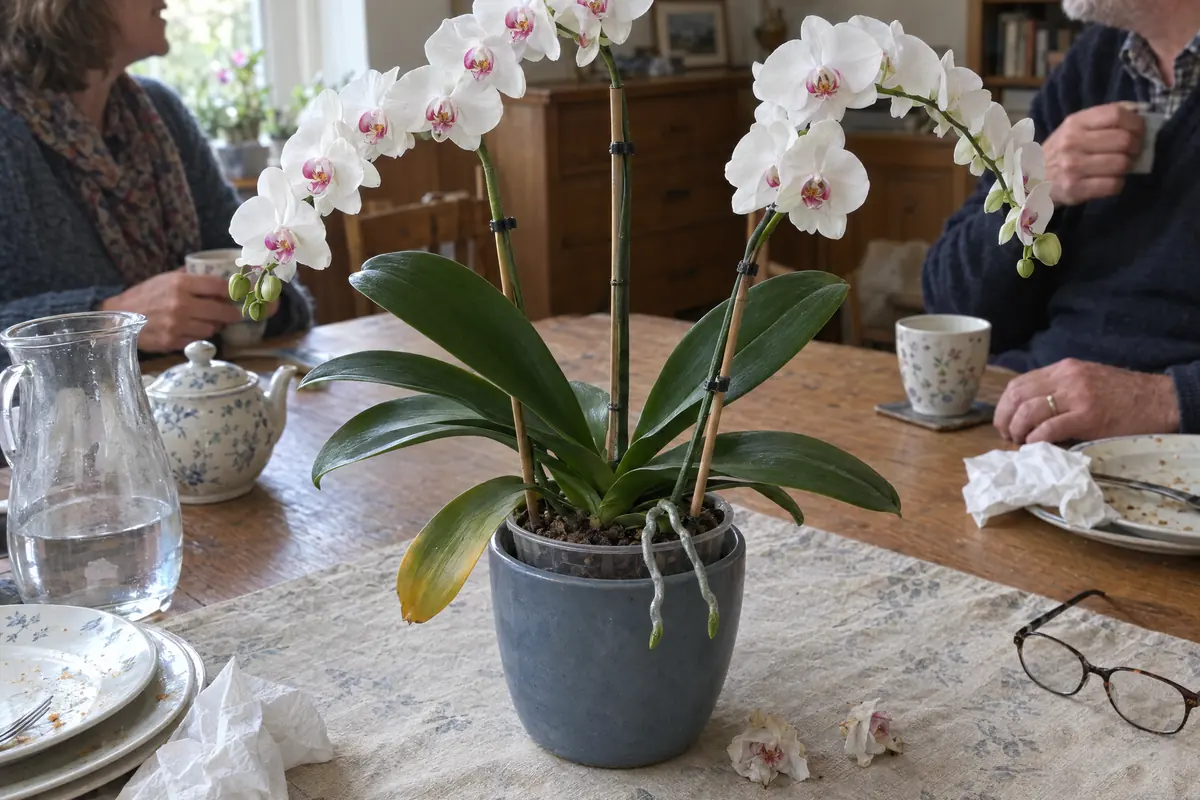
It isn't for everyone, and it's better you know before paying.
- You have an orchid that flowered once and hasn't since
- You can't tell if yours is dead or resting
- You've lost one to rot and want to know exactly what happened
- Someone you love gave you one and you'd like it to outlive the flowers
- You're tired of care tags written for nobody's climate
- Someone asked if they could buy one of yours and you didn't know what to say
- You want a trick that makes it flower next week
- You'd rather have income promises than tables of assumptions with their sources
- You won't read 311 pages. It's long on purpose: a full course in book form
A green thumb was never the missing piece. A few cool weeks were.
You pay, and it's on your phone that same minute.
On your phone next to the pot, on a tablet, or printed for the windowsill. The links also go to your email.
Make the one you have bloom again.
Lost one to rot before? Start here.
- 🌸 The orchid you were given, in flower again
- 🌡️ The cool weeks that bring the spike back
- 📅 What to do each month, in your hemisphere
- 💧 Why it stopped blooming, and why it rotted
🔒 Secure payment by Stripe · Instant download
- On your phone in a minute, no app or account
- The links also go to your email and don't expire
- Pay by card, in your currency
- Stuck with your orchid? A person writes back
The orchid runs on a season. Miss it and it waits a year.
The spike comes after a few weeks of cool days: September to November in the north, March to May in the south. The flowers follow from late winter into spring and last eight to ten weeks. Repotting comes after the last flower drops, once a new root shows. Whoever sets up the cool weeks this autumn can see a spike this winter; whoever waits for "when there's time" waits for next year's autumn.
The book tells you which month each thing happens where you live. The plant keeps its own calendar.
Wondering if it's dead or resting? Volume I answers on page one.
What people ask before buying
I've never kept an orchid alive. Is this too much for me?
Volume I starts from zero, with the plant on the table: what to look at and in what order. Most days it asks you to do nothing at all. Almost everything that kills an orchid is too much: water, love, scissors.
Mine has only leaves and a dry stick. Is it dead?
Almost always it's resting. Check the center where the leaves come from: firm and green means it can grow again. The book shows you how to read the roots and the spike, and what makes a new spike appear.
Will it work in my climate? I'm in the Southern Hemisphere.
Yes. The calendar gives every month in pairs, north and south (autumn is March to May for you), across five climates, from London and Vancouver to Sydney, Darwin and Miami.
I already lost one to rot. What went wrong?
Usually water: the moss plug hidden in the store pot, a cachepot holding water, or watering by the calendar. Chapter VII explains each one, and Chapter XIV covers what can be saved.
Is a book enough, or do I need a course?
It's written as a full course in book form: 311 pages with tables meant to sit by the window and every figure sourced. If videos haven't worked for you, this gives you the order.
What format is it, and can I print it?
Full-color PDF. Read it on your phone, tablet or computer, or print the chapters and tables you need. No app, no account. The links reach you on screen and by email the minute you pay.
Is there a guarantee?
Yes, 90 days. If you haven't downloaded the files, write to contacto@laramaviva.com within 90 days of your purchase and we refund you in full. Once the files are downloaded, the sale is final: they are digital books delivered in full the moment you open them. If you were charged twice or something went wrong with your order, we fix it or refund it at any time.
Another question? Write to contacto@laramaviva.com. A person answers.
The flower falls. The plant stays. Almost the whole craft lies in knowing which is which.
Both volumes, on your phone a minute after you pay.
We use cookies to measure visits. Learn more